
Operating a rough terrain forklift on uneven, soft, or outdoor slopes requires different skills than driving a standard counterbalance truck on flat floors. Rough terrain forklift training provides the specific theory and practical instruction needed to operate rough terrain counterbalance masted lift trucks safely and legally on challenging outdoor surfaces. Ground conditions vary constantly, affecting load stability, traction, and tipping risk. Operators working on construction sites, farms, timber yards, quarries, or unmade ground need training specific to rough terrain, not a standard counterbalance forklift certificate.
Under the Provision and Use of Work Equipment Regulations 1998 (PUWER) and the Health and Safety at Work Act 1974, employers must ensure operators are trained and certified for the specific machine and terrain they work on. A warehouse counterbalance certificate (B1, B2, or B3) does not cover rough terrain. Operators with these certificates need conversion training before legally operating a rough terrain forklift. This page explains what a rough terrain forklift is, legal certification requirements, course content, options, and training benefits.
Throughout this page you will see references to a forklift “licence”. There is no such thing as a forklift licence in the UK. The correct term is a Certificate of Basic Training. We use the word “licence” only where it reflects common search language, but every certificate we issue is a nationally recognised Certificate of Basic Training in accordance with HSE Approved Code of Practice L117.
Call us today on 0117 952 5625 or send an enquiry to book your training course.
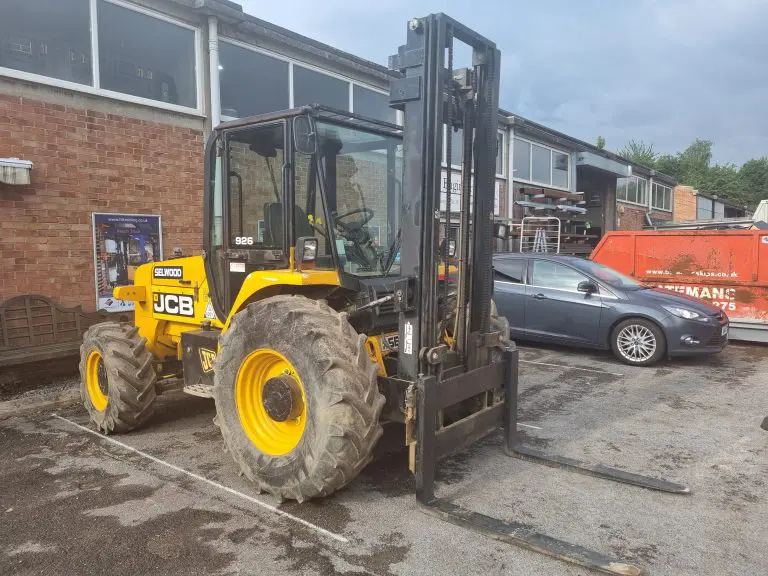
A rough terrain counterbalance masted lift truck is a forklift designed specifically for off-road conditions and rugged environments. It carries loads on forks mounted to a fixed vertical mast, with a heavy counterweight at the rear to balance the load during lifting and travel. In this respect it works on the same principle as a standard warehouse counterbalance truck. The difference is in the chassis, which is built to cope with unmade, uneven or soft ground rather than smooth concrete.
These machines feature large pneumatic or flotation tyres with deep treads for grip on mud, gravel and loose surfaces. High ground clearance protects the undercarriage from debris and uneven terrains. Most rough terrain forklift trucks use four wheel drive systems to maintain traction on slopes and through soft ground conditions. The steering, braking and suspension components are all engineered for the demands of outdoor operation.
It is important to understand that a rough terrain masted lift truck is not a telehandler and is not a variable reach machine. Telehandlers and variable reach trucks, which fall under ABA categories such as J3, J5, J7 and J8, have an extendable telescopic boom that can reach forward and upward. The J1 rough terrain forklift has a fixed mast only, with no boom or variable reach capability. If you need training on a telescopic machine, you can find the correct course on our telescopic forklift training page. If you are unsure which machine your operators use, our friendly team can help you identify the right course.
Secure your place on our next available course. We offer flexible scheduling for novice, experienced and refresher training at our Bristol centre or delivered directly to your site.
Rough terrain forklift training is essential for anyone working in basic construction environments or on construction sites where terrain forklift operation is required. Our courses are designed to comply with industry standards and provide operators with the skills to safely supply and manage loads on uneven ground.
Every rough terrain forklift course covers both theoretical knowledge and practical training, ensuring candidates can safely manoeuvre the machine and handle loads in real outdoor conditions. Courses are tailored to operator experience levels, whether you are a complete novice or an experienced operator needing a refresher.
You will gain a thorough understanding of the legal framework governing rough terrain forklift operation. This covers PUWER 1998 (Regulation 9), LOLER 1998, the Health and Safety at Work Act 1974, and HSE Approved Code of Practice L117. Training also covers your responsibilities as an operator and your employer’s duties under ABA standards.
Candidates learn the structure and controls of the rough terrain masted lift truck, including the mast, counterweight, drive system, hydraulics, safety features and any attachments. This section ensures you understand how the machine differs from a standard warehouse counterbalance or a telescopic handler.
This is where rough terrain forklift training diverges most sharply from warehouse counterbalance training. You will learn how slopes, inclines, soft ground and variable surface compaction affect load stability. Training covers the risks of tip-over, load shift and loss of traction, along with the correct techniques for travel with loads on rough ground.
Before every shift, operators must check tyres, mast, hydraulics, brakes, steering, drivetrain and visibility. You will learn systematic pre-use inspection procedures and how to report defects through your site’s fault reporting system.
Practical training includes manoeuvring the machine laden and unladen, forward and reverse travel, negotiating rough surfaces and inclines, loading and unloading vehicles outdoors, and operating in variable weather conditions including mud and rain. Candidates practice until they can operate the machine safely and confidently across representative rough terrain.
CPCS theory includes a verbal Q&A to assess your knowledge and takes approximately one hour to complete, alongside the 25-question theory test with an 80% pass mark. Training covers all the knowledge you need, including legislation, stability principles, weight estimation, safe operational limitations and the rules that govern rough terrain operation.
The final practical assessment must be completed on representative rough terrain, not flat hardstanding. The CPCS practical test must be completed within eighty minutes. You will be assessed on your ability to safely manoeuvre the machine over uneven ground, handle loads on slopes and demonstrate competent, safe operation in conditions that match real working environments.
See all our telescopic forklift training courses, or use the guide below. Each J-series category is a different machine and needs its own course and certificate. Training on the wrong category means the certificate will not be valid for the machine your operator actually uses.
A vertical mast forklift on an off-road chassis. No telescopic boom.
The standard construction and agricultural telehandler, built for unmade and uneven ground.
A telehandler for hard standing in warehouses, factories and industrial yards.
A rotating turret telehandler, covered by its own dedicated course.
An articulated-frame telehandler with a rough terrain chassis and distinct steering characteristics.
If your machine works both in the yard and on rough ground, or you are unsure which category applies, call us on 0117 952 5625 and we will confirm the right course before you book.
For rough terrain forklift training, on-site delivery is particularly valuable. The whole point of the J1 category is that the machine operates on your ground, in your conditions, with your slopes and surfaces. Training on your own site means your operators gain practical experience on the exact terrain they will work on every day.
Our experienced instructors travel UK-wide to deliver accredited training at your location. Before the course begins, we assess your site to confirm it provides suitable rough terrain for practical training and testing. This includes checking that the area has representative slopes, uneven surfaces and enough space for safe manoeuvring exercises.
On-site delivery also means no travel costs or downtime for your team. Whether you operate on construction sites, farms, quarries, timber yards or outdoor industrial storage facilities, we bring the training to you.
Legal Compliance: Employers must comply with PUWER 1998, LOLER 1998, and the Health and Safety at Work Act 1974 by ensuring operators are trained and certified for the specific machine and terrain. A warehouse counterbalance certificate does not meet these requirements for rough terrain use. Completing J1 training ensures your organisation meets current legislation and ABA standards.
Reduced Accident Risk: According to HSE data (SIR 60), all terrain masted trucks have a risk index of 5.9, higher than many other forklift types. Common accidents include tipping on slopes, unstable ground, and load shifts on uneven surfaces. Proper training equips operators to recognise and manage these risks effectively, preventing incidents.
Site Productivity: Operators who understand how to handle loads efficiently on rough ground work faster and reduce damage to loads and machines. Training covers techniques for navigating slopes, managing traction on soft surfaces, and positioning loads safely outdoors. This leads to fewer delays, less rework, and improved site productivity. It suits new starters and experienced operators moving between construction, warehousing, and outdoor plant environments.
Nationally Recognised Certificate:On successful completion, you receive a nationally recognised certificate with a photo ID card. This provides verifiable proof of competence for employers, auditors, and site managers. Certification is accredited through ITSSAR, AITT and RTITB, meeting industry standards across the UK.
Insurance and Audit Protection:Many insurers and principal contractors require current forklift certification before allowing operators on site. A valid certificate demonstrates compliance during audits and helps protect your business from liability.
| Type | 3:1 | 2:1 | 1:1 | ||||||
|---|---|---|---|---|---|---|---|---|---|
| NOV | EXP | REF | NOV | EXP | REF | NOV | EXP | REF | |
| AITT | 37.5h | 22.5h | 7.5h | 30h | 18.75h | 7.5h | 22.5h | 15h | 3.75h |
| ITSSAR | 37.5h | 22.5h | 7.5h | 30h | 15h | 6.25h | 22.5h | 11.25h | 5h |
| RTITB | 42.5h | 23h | 8.5h | 33h | 19.5h | 7.25h | 25h | 15h | 5.5h |
Course duration depends on the experience level of candidates and the number of delegates attending. Get in touch and we will confirm timings based on your specific requirements.
The certificate covers the operation of a rough terrain counterbalance masted lift truck (J1 category) on uneven, unmade and outdoor ground. It demonstrates that the holder has completed both theory and practical assessment and is competent to operate this specific machine type. It does not cover telescopic handlers, variable reach machines, or standard warehouse counterbalance trucks. Site-specific familiarisation is still required whenever an operator moves to a new location.
A rough terrain masted forklift (J1) has a fixed vertical mast, just like a warehouse counterbalance but built for rough ground. A telehandler has an extendable telescopic boom that can reach forward and upward. They are different machines with different stability characteristics, different controls and different training requirements. If you need telehandler training, see our telescopic forklift training page for the correct course.
Rough terrain forklift training cost depends on the experience level of candidates, the number of delegates, and whether training is delivered on your site or at our Bristol training centre. We do not publish fixed prices because every booking is tailored to your requirements. Contact us or call 0117 952 5625 for a quote with no hidden costs.
A rough terrain forklift certificate is valid for 3 to 5 years. Refresher training is recommended at that interval to maintain your certification and keep your skills and knowledge current. Some employers and site operators may require refresher training sooner, particularly after a long absence from operation or following an incident.
No prior experience is needed for the novice course. We offer four experience levels to match every candidate. Novice courses are for those with no previous forklift experience. Courses for experienced operators are suitable for those who have been operating informally but do not hold a formal certificate. Conversion courses are for operators who already hold a counterbalance or other forklift certificate and need to add rough terrain to their skills. Refresher courses are for certificated operators whose certification is due for renewal.
Rough terrain forklift training ensures your operators can work safely and legally on the ground conditions your business demands. Whether your team works in construction, agriculture, quarrying or any outdoor industrial environment, HL Training delivers accredited, nationally recognised certification through ITSSAR, AITT and RTITB.
Book your course today. Call us on 0117 952 5625 or send an enquiry to register your interest and receive a quote. Our friendly team will help you choose the right course level and arrange training on-site or at our Bristol training centre.
This website uses cookies to improve your experience. Choose what you're happy with.
Required for the site to function and can't be switched off.
Help us improve the website. Turn on if you agree.
Used for ads and personalisation. Turn on if you agree.