

Pivot steer forklift training is the accredited course for operators who use an articulated forklift, often called a Bendi forklift, Flexi truck or Aisle-Master. These trucks bend in the middle so the forks can turn into the racking from inside a narrow aisle, giving warehouses the reach of a counterbalance truck with the space saving of narrow aisle storage. HL Training covers both pivot steer categories: P1 rider operated and P2 pedestrian operated. Each course gives your team the skills, safety knowledge and nationally recognised certificate to operate a pivot steer truck safely, from articulated steering and stability to stacking, de-stacking and loading lorries.
You may see it called a Bendi licence, but UK law does not require one. The correct qualification is a Certificate of Basic Training, issued after completing an accredited course.
We deliver accredited Bendi forklift training under ITSSAR, AITT and RTITB standards, with novice, experienced, conversion and refresher courses on-site anywhere in the UK or at our Bristol training centre, where we train on our own Flexi forklift and Bendi truck.
Call us today on 0117 952 5625 or send an enquiry to book your course.
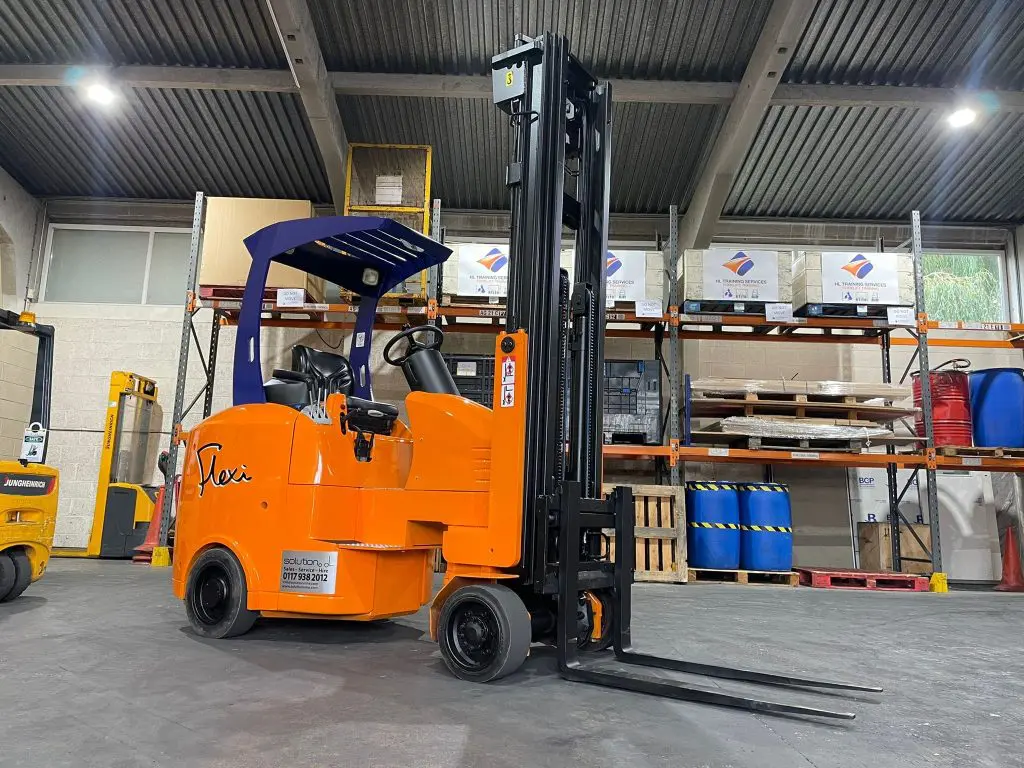
A pivot steer forklift, also called an articulated forklift, is a counterbalance truck with an articulated chassis. The front section, which carries the mast and forks, pivots on a central joint, so the operator can swing the forks up to around 90 degrees either way to face the racking on both sides of the aisle without turning the whole truck. In effect it combines the outdoor ability of a counterbalance truck with the narrow aisle stacking of a reach truck. That lets a pivot steer truck work in narrow aisles that a standard counterbalance forklift or reach truck could not use.
The best-known names are Bendi, Flexi and Aisle-Master (made by Combilift), which is why operators often search for Bendi forklift training or Flexi forklift training rather than the category name. Whatever the badge, they are all pivot steer trucks and fall under the same training categories.
Unlike a very narrow aisle truck, most pivot steer forklifts are not wire guided and many have the ability to work indoors and outdoors, making them one of the most versatile pieces of material handling equipment in a warehouse. The same truck can unload lorries in the yard, carry pallets into the warehouse and put them away at height in a narrow aisle. That versatility is the main reason businesses choose them, and it is also why the operator needs specific training: the truck behaves differently from a conventional forklift in every one of those tasks.
There are two pivot steer categories, and each needs its own course and certificate. Both categories share the same core skills, but the controls and risks differ, so an operator trained on one needs conversion training before operating the other.
On a P1 truck, the operator sits in the truck and drives it like a counterbalance forklift, using a steering wheel to articulate the chassis. P1 trucks are the full-size Bendi and Flexi machines used across distribution centres, builders merchants, cold stores and manufacturing sites, often moving between the yard and the warehouse throughout the day. Most delegates on our Bendi forklift training courses train on P1.
On a P2 truck, the operator walks with the truck and controls it with a tiller arm or pedestrian controls, rather than riding in a cab. P2 trucks suit smaller stores, shops, stockrooms and narrow aisle areas where a ride-on truck would be too large or not needed. The articulated steering works in the same way, but the operator also has to manage their own position, walking speed and the crush risk between the truck, the load and the racking.
Pivot steer trucks let businesses fit more racking into the same building, because aisle widths can be much narrower than a standard counterbalance truck needs. Many sites choose them as part of their warehouse design so they can gain storage capacity without moving to bigger premises, while keeping one truck for both indoor and outdoor work.
That efficiency depends on skilled operators. Working close to racking, in tight spaces, with a chassis that bends in the middle means small errors can damage stock, racking and the truck itself, and put people at risk. Every operator needs to understand the specific model, its rated capacity at each lift height and the effect of articulation on stability before every task.
We offer flexible scheduling for novice, experienced, conversion and refresher courses at our Bristol centre or delivered directly to your site.
Every pivot steer training course combines theory and practical training, assessed to national standards and suited to each delegate’s previous experience. Our novice route is designed for beginners with little or no experience: we start with an introduction to how a pivot steer truck works and build to safe operation, so delegates leave with the skills and knowledge to work safely and efficiently.
The course covers PUWER 1998, LOLER 1998, the Health and Safety at Work etc Act 1974 and the HSE Approved Code of Practice L117, in line with HSE guidance, so operators understand their legal responsibilities, the employer’s duty of care, and why only trained and authorised people may operate a forklift.
Instructors explain the controls and instruments, the mast and hydraulic system, the articulation joint and every safety device fitted, using the manufacturer’s handbook for the model the delegate will operate, plus battery care or LPG cylinder changing where it applies. Delegates can also buy our pivot steer and Bendi forklift operators manual as a reference after the course.
How articulated steering responds at different speeds, why stability changes as the truck articulates, and why turning sharply with a raised load is a major risk. It also covers how load centres and lift height affect stability, and how to manage rear-end swing when articulating close to racking and people. Delegates learn to travel with the forks lowered, keep turns smooth and controlled, and manage ramps and inclines safely.
How to approach the racking, articulate the chassis to face the pallet location, and stack and de-stack at different heights with the load square and secure. Training covers load handling for a range of pallets and other loads in narrow aisles where space on each side is limited.
Where it applies to your operation, the course covers loading and unloading vehicles, working in the yard and on uneven surfaces, and moving safely between outdoor areas and the warehouse.
Keeping pedestrians clear of the working area, managing restricted visibility at aisle ends and around racking, using horns and lights correctly, and knowing what to do in an emergency, such as a load becoming unstable or the truck developing a fault while lifting.
How to carry out a systematic daily check covering the mast, chains, forks, hydraulics, tyres, the articulation joint, battery or LPG system and safety features, plus running checks once the truck is started, and how to report defects.
The theory testing element is 25 multiple-choice questions with an 80% pass mark, covering legislation, stability, hazard awareness and operator responsibilities.
The practical tests assess safe operation across a range of tasks, including pre-use checks, articulated manoeuvring, and stacking and de-stacking. Delegates must pass both the theory and practical testing before their certificate is issued on successful completion of the course.
Each forklift category is a different machine and needs its own course and certificate. Training on the wrong category means the certificate will not be valid for the truck your operator actually uses.
The operator sits in the truck and steers the articulated chassis.
The operator walks with the truck and controls it with pedestrian controls.
Wire or rail guided very narrow aisle trucks with a turret head.
Free-steering reach trucks for standard narrow aisle warehouses.
Multi-directional and Combilift-style trucks for long loads.
Standard rider operated counterbalance forklifts.
If your operators already hold a counterbalance or reach truck certificate and now need to use a Bendi or Flexi, our conversion courses are usually the quickest route. Call us on 0117 952 5625 to discuss your team and we will confirm the right course before you book.
On-site delivery means your team trains on the Bendi forklift trucks they will actually use, in the aisles, yards and loading bays they work in every day. Assessments reflect your real racking, aisle widths and loads, which is the fastest way to build competence that transfers straight back to your warehouse operations. On-site training is the usual route for P2 pedestrian trucks, so delegates learn on the exact model and layout they will use.
We deliver Bendi forklift training at warehouses and sites across the UK and can arrange training days around your shifts, so the operation keeps moving while your team trains.
Prefer to send delegates to us? Our Bristol site at Barton Hill Trading Estate has its own Flexi forklift and Bendi truck and delivers the same ITSSAR, AITT and RTITB standard in a controlled setting. See our upcoming course dates for the next available start date.
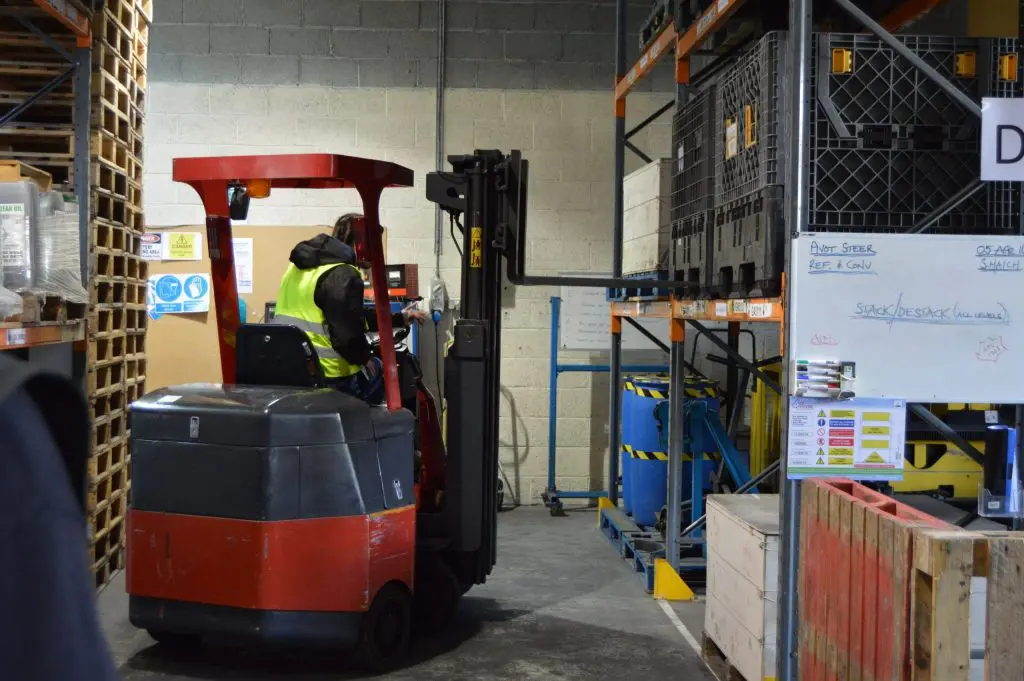
Legal Compliance: Under PUWER 1998, LOLER 1998 and the Health and Safety at Work etc Act 1974, employers must make sure anyone operating lifting equipment is properly trained and competent. Accredited Bendi forklift training gives you documented evidence that you have met that duty, and the HSE Approved Code of Practice L117 also expects employers to authorise competent operators in writing. A counterbalance certificate does not cover an articulated forklift.
Reduced Accident Risk: The biggest dangers with a pivot steer forklift are instability when turning with a raised load, collisions with racking in narrow aisles, and people being caught near the truck. Accredited training teaches operators to recognise these risks and minimise them on every lift.
Warehouse Productivity: A trained operator moves through narrow aisles efficiently, places pallets accurately first time and avoids damage to stock and racking. That means better efficiency in day-to-day warehouse operations, less downtime and better use of the storage space your business has invested in.
Nationally Recognised Certificate: Every delegate who passes the theory and practical testing receives a Certificate of Basic Training with photo ID card under ITSSAR, AITT or RTITB standards, recognised by employers across warehousing, logistics, manufacturing and builders merchants.
Insurance and Audit Protection: Insurers, HSE inspectors and your own customers all expect evidence of competence. Accredited certification and training records keep your business compliant when an audit, inspection or incident investigation takes place.
| Type | 3:1 | 2:1 | 1:1 | ||||||
|---|---|---|---|---|---|---|---|---|---|
| NOV | EXP | REF | NOV | EXP | REF | NOV | EXP | REF | |
| AITT | 37.5h | 22.5h | 7.5h | 30h | 22.5h | 7.5h | 22.5h | 15h | 3.75h |
| ITSSAR | 37.5h | 22.5h | 7.5h | 30h | 15h | 6.25h | 22.5h | 11.25h | 5h |
| RTITB | 42.5h | 23h | 8.5h | 33h | 19.5h | 7.25h | 25h | 15h | 5.5h |
Course duration depends on the accrediting body, the delegate’s experience and the group size (1:1, 2:1 or 3:1). As a guide for P1 rider operated pivot steer, novice courses take three to six days, experienced operator courses one and a half to three days and refresher courses half a day to just over a day. P2 pedestrian courses and conversion training are quoted individually. Full hours by accrediting body and ratio are shown in the Course Timings table. For training in Bristol, see our upcoming course dates, or contact us to agree dates and duration for on-site training.
A Bendi forklift is an articulated, pivot steer counterbalance truck. Its front section pivots on a central joint so the forks can turn into the racking from inside a narrow aisle. Bendi is a brand name, but it is widely used for any pivot steer truck.
Yes. A Bendi is a type of counterbalance forklift with articulated steering. It is a separate training category, so a standard counterbalance certificate does not cover it and operators need pivot steer training first.
P1 covers rider operated pivot steer trucks, where the operator sits in the truck. P2 covers pedestrian operated pivot steer trucks, where the operator walks with the truck and uses pedestrian controls. They are separate categories, each with its own course and certificate.
Yes. Flexi, Aisle-Master and Bendi trucks are all pivot steer trucks and fall under the P categories. Tell us the make and model your team uses and we will match the course to it.
There is no legal Bendi licence in the UK. Employers need proof of training: a Certificate of Basic Training from an accredited course, followed by familiarisation on their site and written authorisation from the employer. Most employers refresh training every three to five years, or sooner after a long break from operating, an incident, or if unsafe practice is observed.
Yes. Operators with previous experience on other forklift trucks can usually take a shorter conversion course focused on articulated steering, stability and narrow aisle stacking. We quote conversion courses individually.
It depends on experience and group size. For P1, novice courses take three to six days, experienced operator courses one and a half to three days and refresher courses half a day to just over a day. Smaller groups finish faster because each delegate gets more time on the truck.
We do not publish fixed prices because cost depends on experience level, the number of delegates, whether training is on-site or in Bristol, and travel. Contact us for a clear quote with no hidden costs.
Get your team trained and certified on rider and pedestrian pivot steer trucks, including Bendi, Flexi and Aisle-Master models. Our training service delivers accredited pivot steer and Bendi forklift training with nationally recognised certification, on-site across the UK or at our Bristol training centre, with flexible scheduling and clear pricing. For further information or to check course dates, get in touch.
HL Training · 0117 952 5625 · Enquire Now
This website uses cookies to improve your experience. Choose what you're happy with.
Required for the site to function and can't be switched off.
Help us improve the website. Turn on if you agree.
Used for ads and personalisation. Turn on if you agree.